
Buying a surface-stress meter because “we need PC software” is not yet a workflow decision. The real buyer question is what must happen after a reading: who identifies the sample, who checks the measurement condition, who reviews the result, and which data or report requirements are standard versus project-specific.
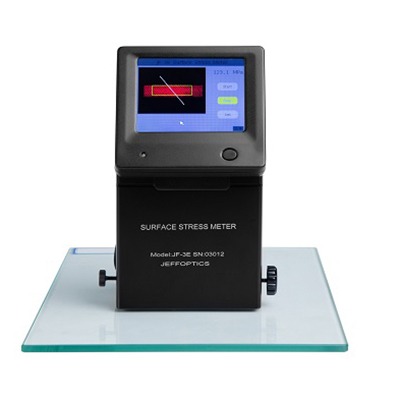
JF-3E is an automatic surface-stress meter for thermally toughened, heat-strengthened, annealed, and tin-side float glass. JF-3E includes PC software and a PDA with a 3.5-inch touch screen. Its measurement range is 200 MPa (29,000 psi), with a calculation speed of 0.5 second. For the listed glass scope, that makes JF-3E a strong candidate when a team needs to define a more structured measurement-and-review workflow without pretending that every database, report, API, or line connection already exists.
JF-3E Facts That Shape a PC-Involved Measurement Workflow
| Confirmed JF-3E detail | Why it matters to the buyer’s review |
|---|---|
| Automatic meter for named thermally toughened, heat-strengthened, annealed, and tin-side float glass | Start with the actual material and glass-side scope. |
| PC software and 3.5-inch PDA | A buyer can define how the measurement station and PC participation should be reviewed. |
| 200 MPa / 29,000 psi range; 0.5-second calculation speed | Check the proposed measurement range and workflow expectation against the listed model configuration. |
| 0.1 MPa, 15 psi, or 0.1 degree resolution | Include the required unit and resolution in the technical brief. |
| Laboratory, production-line, and field-testing positioning | The operating context can be discussed, but site integration still needs a project review. |
| Separate JF-3H variant with a curved prism for 200 mm-radius surfaces | Curvature is a selection input, not an assumption about every JF-3E configuration. |
Resolution is 0.1 MPa, 15 psi, or 0.1 degree.
A PC Workflow Starts With Ownership, Not a Screen Wish List
Industry teams often ask for “software” when the deeper issue is that readings are hard to compare across samples, shifts, or investigation stages. A software requirement may mean a buyer needs a clearer operator routine, a defined review handoff, retained records, a customer-specific report, or a connection to another quality system. Those are different projects and should not be collapsed into a generic promise.
JF-3E includes PC software and a PDA with a 3.5-inch touch screen. That is a direct product fact. It creates a credible starting point for a PC-involved measurement discussion. It does not establish a current database, cloud service, API, MES/ERP link, report template, or automatic release rule. Keeping that boundary clear is what turns an early inquiry into a qualification conversation instead of a later mismatch.
Three Decisions to Make Before You Specify the Workflow
1. Match the instrument to the actual glass task
JF-3E is an automatic surface-stress meter for thermally toughened, heat-strengthened, annealed, and tin-side float glass. Establish the glass type, treatment, side, thickness, curvature, measurement location, and target unit before discussing data flow. The listed range is 200 MPa (29,000 psi), and the calculation speed is 0.5 second; both are valuable selection facts, not a promise of a particular station cycle or plant output.
For curved surfaces, JF-3H is a separate JF-3E variant with a curved prism for surfaces with a 200 mm radius. That is precisely why sample geometry belongs in the first technical exchange. A buyer should not assume the base configuration or a related variant fits every curved part.
2. Define the review handoff around the measurement
The most useful PC workflow begins with plain questions: What sample ID follows the measurement? Which operator or team verifies the setup? What result requires a second check? Who owns the final acceptance decision? Which fields need to reach a customer, laboratory, or quality manager?
JF-3E can support a structured measurement discussion because it combines an automatic instrument with PC software and a PDA. The buyer can then state what is needed beyond that confirmed scope. For example, a team may require a record structure, a report layout, a database, an export format, or an integration with another system. Treat those as explicit engineering requirements, not as features silently inherited from the word “software.”
3. Use a custom route when the required data path is not standard
The product is positioned for laboratory, production-line, and field testing. That makes the environment relevant to the evaluation, but it does not pre-approve a particular line layout or software connection. When the buyer needs customised reporting, a fixture, an automated handoff, or a system interface, Jeffoptics can evaluate hardware development, software development, and system integration after the project requirement is defined.
This is the better commercial route for non-standard requests. Send the sample profile, measurement points, operator flow, expected volume, data fields, report or interface requirement, acceptance method, budget range, and timeline. The outcome can then be a standard product fit, a modified workflow worth reviewing, or a custom project requiring feasibility work.
When JF-3E Is Worth Evaluating
JF-3E is worth evaluating when a team needs automatic surface-stress measurement within its named glass scope and wants PC involvement to be part of a defined operational workflow. It is especially relevant when the current task spans laboratory, production-line, or field testing but the buyer is prepared to separate confirmed instrument facts from custom data or integration requirements.
Compare it with the JF-1E Glass Surface Stress Meter when the task is a PDA-assisted tin-side DSR workflow. For product details, see the JF-3E Glass Surface Stress Meter and the Surface Stress Meter range.
What to Include in a PC-Workflow RFQ
- Glass type, treatment, tin-side requirement, thickness, curvature, and sample dimensions
- Target stress range, unit, measurement locations, and current method
- Sample volume, operator count, and laboratory, field, or production context
- Required record fields, report format, database, export, API, or integration requirement
- Acceptance owner, reference method, quantity, destination, budget range, and schedule
FAQ
Does JF-3E PC software mean it already includes MES/ERP integration?
No. JF-3E includes PC software and a PDA. MES/ERP, API, database, report, and other integration requirements should be defined for a project review.
Does 0.5-second calculation speed define the total station cycle time?
No. It is the stated calculation speed. Sample handling, setup, review, data routing, and site conditions determine the total workflow.
Is JF-3E the right choice for every curved glass sample?
No. Curvature must be reviewed. JF-3H is a separate JF-3E variant with a curved prism for surfaces with a 200 mm radius.
Post time: Aug-19-2026