
A manual surface-stress meter is not a fallback for buyers who “cannot justify automation.” It is a distinct measurement choice. For the right laboratory or quality-control team, manual operation can make the observed image, fringe angle, and calculation route explicit. For the wrong workflow, it can create an uncontrolled dependency on operator practice.
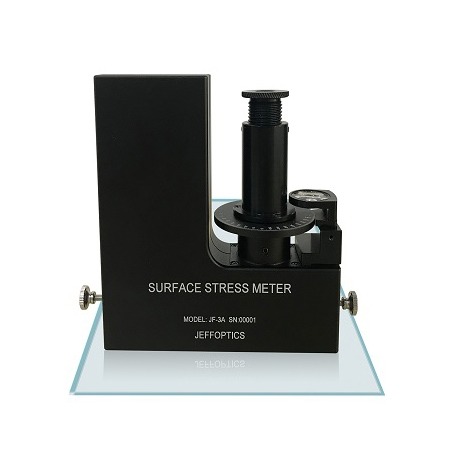
JF-3A is applied to surface-stress measurement on the tin side of thermally toughened, heat-strengthened, annealed, and float glass. It is the basic JF-3 series version and is fully manually operated. The wedge-angle options are 1°, 2°, and 4°, with 1-degree resolution. The measurement ranges are 0–95 MPa and 0–185 MPa. Those facts make JF-3A worth evaluating when the buyer needs a direct manual method and can define the sample, tin-side condition, target range, operator procedure, and acceptance context.
The key decision is not whether an operator can read one result. It is whether the buyer can run the same controlled method across the samples and decisions that matter: routine checks, process comparison, a laboratory investigation, or a technical discussion with a customer or supplier.
JF-3A facts that affect buyer fit
| Buyer question | JF-3A fact | What the buyer should decide |
|---|---|---|
| What is the operating model? | JF-3A is the basic JF-3 series version and is fully manually operated. | Decide whether the team has a named operator method, training, reference sample, and repeat-check process. |
| How is the stress value obtained? | The meter uses an eyepiece and a protractor dial. The operator recognizes the fringe angle manually and uses the Angle-Stress table to obtain the stress value. | Define who reads the fringe, how the table is used, and when a second reading is required. |
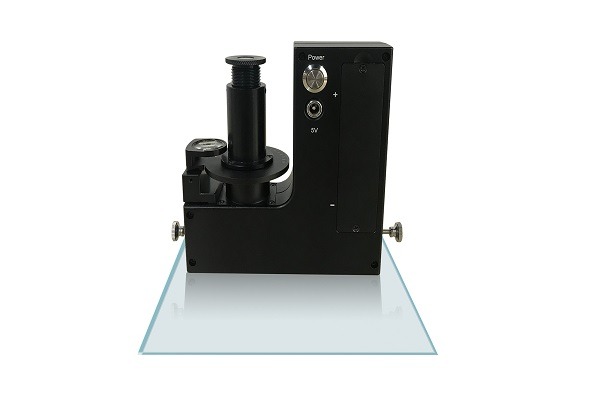
| How is the view adjusted? | A prism is located at the bottom of the instrument, and two adjustable knobs control the image and light direction. | Confirm tin-side access, optical condition, sample support, and a controlled setup sequence. |
| Which ranges are available? | The wedge-angle options are 1°, 2°, and 4°, with 1-degree resolution. The measurement ranges are 0–95 MPa and 0–185 MPa. | Match the target range and test purpose before choosing the instrument configuration. |
| Which glass task is stated? | JF-3A measures the listed thermally toughened, heat-strengthened, annealed, and float glass on the tin side. | Do not extend the scope to unconfirmed materials, sides, geometries, or applications. |
1. Choose manual operation when the method needs to be visible
With JF-3A, the measurement process is intentionally visible: the operator uses the eyepiece and protractor dial, recognizes the fringe angle, and applies the Angle-Stress table to obtain the stress value. That can be a useful fit when a laboratory wants its team to understand the observed method rather than simply receive an automated output.
The buyer value comes from a more deliberate procedure, not from a claim that manual operation is automatically more accurate, faster, cheaper, or independent of skill. A good manual workflow answers five questions before routine use:
- Which glass types and tin-side conditions will be measured?
- What target range or comparison result matters to the buyer?
- Who is trained to set the view, read the fringe, and apply the table?
- What reference sample or repeat-reading rule is used when results differ?
- Who owns the acceptance or escalation decision after the result is obtained?
When those questions are unanswered, the buyer does not yet have a manual workflow; it only has a device request. That is the right point to request a technical review rather than to overstate a standard fit.
2. Make image and light adjustment part of the procedure
JF-3A has a prism at the bottom of the instrument. Two adjustable knobs control the image and light direction. These are not decorative hardware details. They are the controls that make setup part of the measurement conversation.
For a quality team, the practical consequence is simple: document the sample position, selected side, view adjustment, light direction, reading method, and comparison basis. That gives the next operator a defined routine to follow and gives the laboratory manager a clearer basis for deciding whether two results should be compared, repeated, or escalated.
The product’s stated tin-side scope matters here. Do not assume that a different glass side, a complex coating, unusual optical behavior, curved geometry, or a different material automatically follows the same route. Send representative sample details and the actual measurement objective so Jeffoptics can compare a standard JF-3A fit with another model, a changed configuration, or a custom-project discussion.
3. Start from the target range, not the product name
Buyers often search “manual meter for tempered glass” before they have defined the stress range that their quality decision needs. JF-3A has 1°, 2°, and 4° wedge-angle options, 1-degree resolution, and 0–95 MPa or 0–185 MPa measurement ranges. These facts should lead the selection conversation.
Ask the buyer to state the expected target range, the sample condition, the reason for the measurement, the reference method, and the result that needs to be compared. That enables a focused discussion about whether JF-3A is the right manual route, whether an automatic workflow such as JF-3E should be evaluated, or whether the project requires a modified or custom solution.
When JF-3A is worth evaluating
JF-3A is worth evaluating when the buyer can establish a manual method around:
- Thermally toughened, heat-strengthened, annealed, or float glass on the tin side.
- A specified target range within the stated 0–95 MPa or 0–185 MPa routes.
- An operator who can set the image and light direction, recognize the fringe angle, and use the Angle-Stress table.
- A reference sample, repeat-reading rule, acceptance owner, and escalation path.
- A laboratory, R&D, or quality-control workflow where manual observation is appropriate to the sample count and decision need.
It is time to discuss another route when the buyer requires high-frequency checks, multiple operators with a more structured workflow, automatic calculation, PC/data/report functions, a complex geometry, an unconfirmed glass condition, or station integration. Jeffoptics can evaluate a standard alternative, a modified workflow, or a tailored hardware, software, fixture, reporting, or system-integration project after it reviews the requirement.
What to send in a JF-3A RFQ
- Glass type, treatment, tin-side condition, sample dimensions, thickness, curvature, coating, and optical condition.
- Target stress range, measurement locations, current method, reference sample, and the decision the result must support.
- Expected sample volume, frequency, number of operators, operator-training needs, and repeat-reading process.
- Applicable standard or internal specification, acceptance owner, documentation requirements, and any need beyond manual operation.
- Quantity, destination, budget range, schedule, installation/training need, and whether an automatic or custom route is acceptable.
For product details, see the JF-3A page and the Surface Stress Meter category.
FAQ
Is JF-3A fully automatic?
No. JF-3A is fully manually operated. The operator observes the fringe angle and uses the Angle-Stress table to obtain the stress value.
Can JF-3A measure every type of tempered glass?
No. Its stated scope is thermally toughened, heat-strengthened, annealed, and float glass on the tin side. Other conditions require a technical fit review.
Does JF-3A create automatic reports or cloud records?
Those functions are not confirmed as current JF-3A features. Submit the required data, report, automation, or integration workflow for a separate feasibility review.
Is a manual reading sufficient for release or compliance?
No. The buyer must define its own method, reference sample, acceptance criteria, documentation, and final decision owner.
When should a buyer compare JF-3A with an automatic model?
Compare routes when sample count, operator consistency, calculation, data, reporting, geometry, or station integration moves beyond a controlled manual workflow.
Post time: Aug-05-2026