
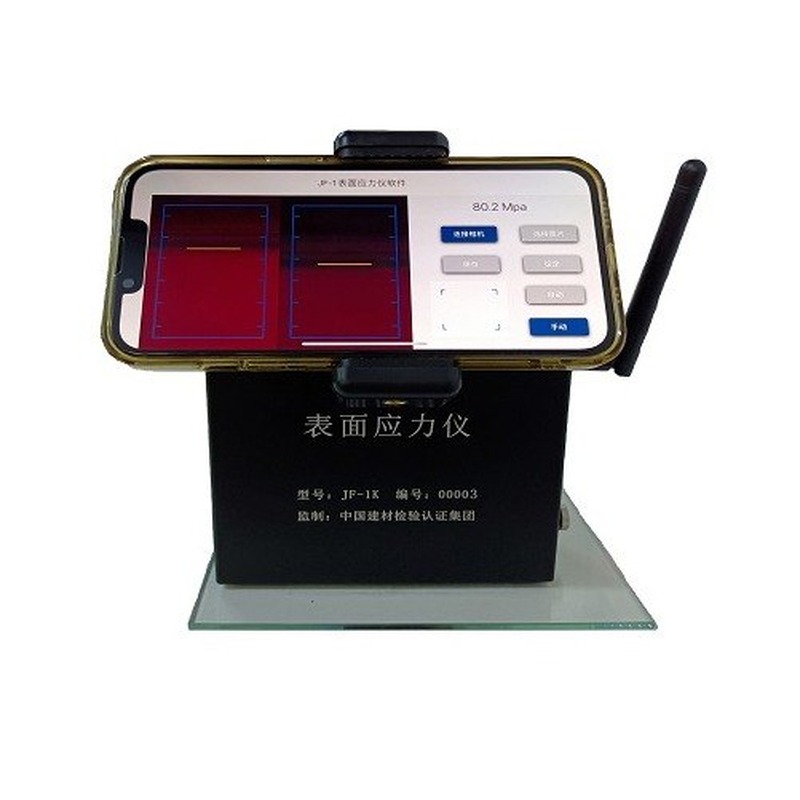
JF-1Wifi is applied to surface-stress measurement of thermally toughened, heat-strengthened, and annealed glass on the tin side using the enhanced GASP method. The stress meter connects to a mobile phone through WiFi, and stress-value calculation, recording, and stress-meter settings can be completed on the mobile phone. For a team with several operators or inspection locations, that is a practical reason to evaluate a wireless handoff rather than assume every reading must be managed at a fixed workstation.
The product has three versions: a tempered soda-lime glass version, a tempered borosilicate glass version, and a multi-functional dual-light-source version for tempered soda-lime and tempered borosilicate glass. The measurement range is 15–300 MPa. The right question is which glass, operator, phone, record, and site conditions the buyer needs to control.
It includes a mobile phone and phone mount for attached or detached use.
JF-1Wifi Facts That Shape a Multi-Operator Evaluation
| Confirmed detail | Why it matters |
|---|---|
| Enhanced GASP, tin-side scope | Define the glass treatment and measurement side before a trial. |
| Soda-lime, borosilicate, and dual-light versions | Version choice can follow the actual glass mix rather than a generic “wireless” label. |
| WiFi connection to a mobile phone | Review movement, handoff, and site IT constraints before deployment. |
| Phone calculation, recording, and meter settings | The operator can keep basic workflow actions close to the sample. |
| 15–300 MPa range | Compare the expected process window with the listed boundary. |
| Phone and mount included for attached or detached use | Decide whether the phone stays with the meter or is positioned separately. |
The Multi-Operator Problem Is a Handoff Problem
When three operators use the same meter, the weak point is often not the instrument. It is the handoff: who confirms the glass side, who enters or reviews the result, which sample identifier is used, and where a questionable reading goes next. A wireless phone workflow can make those decisions visible, but it cannot replace a training plan or quality owner.
JF-1Wifi gives a team a concrete workflow to test. The phone can calculate, record, and configure the meter, while the phone mount supports attached or detached use. That can be useful for line-side checks, supplier visits, and laboratory work, subject to the sample and site review.
Three Reasons to Put JF-1Wifi on an Evaluation List
1. Make operator handoff easier to observe
Define a short handoff script: confirm treatment and tin-side access, identify the sample, capture the reading, and record the action. Because the phone is part of the workflow, a supervisor can review whether the same fields are used across operators. This is a process benefit to validate, not a guaranteed repeatability claim.
2. Match the version to the glass program
Soda-lime and borosilicate programs do not automatically share the same optical requirement. Start with the glass composition and treatment, then compare the single-glass versions with the multi-functional dual-light-source version. Send sample photos and target ranges rather than asking for a quote based only on the word “wireless.”
3. Define phone and IT constraints before purchase
Ask whether the phone will be attached or detached, whether the inspection area permits WiFi, what records must leave the phone, and whether the customer’s IT policy restricts devices. If the buyer needs cloud synchronization, an API, a specific phone model, or a controlled database, describe it as a project requirement for review. Jeffoptics can evaluate a standard workflow or a tailored software/integration route when the requirement is clear.
When a Wireless Workflow Is the Better Inquiry
JF-1Wifi deserves evaluation when operators move between samples and need calculation, recording, and settings in a phone-led workflow. It is less useful to make the decision from the word “wireless” alone if the glass, treatment, range, or record path remains undefined.
Compare the JF-1E Glass Surface Stress Meter when a PDA image/result view is more important, or review the JF-3A Glass Surface Stress Meter when a fully manual field method is the right baseline.
Send These Inputs for a Multi-Operator Review
- Glass family, treatment, tin-side access, thickness, and target range
- Number of operators, locations, and handoff points
- Phone attachment preference and WiFi/IT restrictions
- Required record fields, export path, and review owner
- Sample photos, quantity, destination, budget, and schedule

FAQ
Does WiFi mean the results are automatically in a cloud database?
No. The product description confirms a WiFi connection to a mobile phone and phone-side calculation, recording, and settings. Cloud or API requirements need separate review.
Which JF-1Wifi version should every buyer choose?
None should be selected without confirming the glass. Compare soda-lime, borosilicate, and dual-light requirements with representative samples.
Does a phone workflow guarantee identical readings between operators?
No. It can make handoff and records easier to define, but training, sample method, and buyer-owned correlation still matter.
Post time: Aug-25-2026