
For chemically strengthened glass, surface compression is only one part of the process question. A development or quality team may also need depth of layer, central tension, and a view of how stress changes through the glass. JF-4 Series is developed to automatically measure surface stress of chemically tempered and thermally tempered glass. The product uses the optical waveguide effect for calculation of surface compression stress, depth of layer, and central tension stress for tempered glass.
The measurement range is 1000 MPa or 1500 MPa, and the depth ranges are 5–50 µm, 10–100 µm, and 10–200 µm. Those figures provide a concrete starting point for evaluating an instrument against the chemistry, sample, and decision that the buyer needs to make.
JF-4 Series Facts That Shape CS and DOL Evaluation
| Confirmed detail | Why it matters |
|---|---|
| Automatic measurement for chemically and thermally tempered glass | The buyer can compare an automatic workflow with the required process and laboratory decision. |
| Optical-waveguide calculation of surface compression, depth of layer, and central tension | The team can define multiple stress outputs instead of treating surface compression as the whole profile. |
| 1000 MPa or 1500 MPa measurement range | Expected stress and selected range must be aligned before quotation. |
| 5–50, 10–100, and 10–200 µm depth ranges | The ion-exchange target and depth-of-layer question should drive the configuration discussion. |
| PC software for single, continuous, distribution, records, and printed reports | Measurement mode and result-review requirements can be planned together. |
| Double-ion-exchange features, distribution display, CSV recording, and report export in newly released software | Buyers with advanced process-development needs can specify the data workflow for review. |
| Customization according to requirements | Changed sample, range, workflow, or output needs can become a tailored evaluation instead of an unqualified fit claim. |
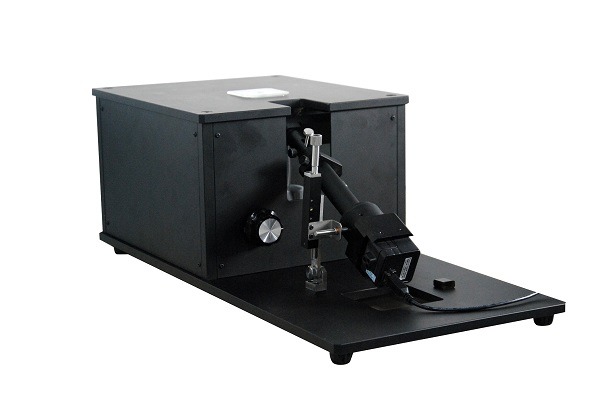
Configuration Reference for RFQ Planning
This public configuration reference covers the JF-4 Series automatic optical-waveguide measurement role, CS/DOL/CT outputs, specified stress and depth ranges, PC software functions, double-ion-exchange software features, and customization statement. Confirm glass composition, ion-exchange route, sample geometry, target range, and required output before quotation.
1. Define the Output Before Choosing the Instrument
A chemically strengthened-glass project may ask for surface compression, depth of layer, central tension, or a broader stress-distribution view. JF-4 Series is built around those distinct outputs, so the first technical conversation should state which values are needed for process development, incoming inspection, batch comparison, or failure investigation.
The optical-waveguide effect supplies the calculation basis for the stated outputs. That does not eliminate the need to define the glass composition, treatment route, target range, sample geometry, and acceptance method. Those inputs determine whether the current configuration is a responsible candidate.
2. Use the PC Workflow for Single and Continuous Review
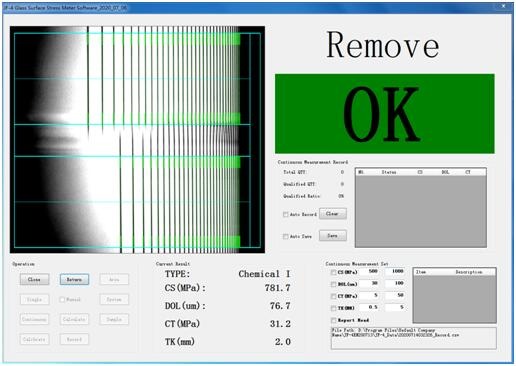
The PC software supports single measurement, continuous measurement, chemical-glass stress-distribution inspection, records, and printed reports. Newly released software includes features suitable for double ion-exchange glass, stress-distribution display, continuous measurement, continuous CSV recording, and report export.
This range of workflow options matters when a laboratory moves between one-off development samples and structured batch review. A buyer can specify whether the result needs to be observed once, compared continuously, retained as a record, printed for a review file, or exported for a wider quality process. Any database, API, or enterprise interface beyond these functions should be treated as a custom requirement.
3. Screen Chemistry and Depth Range Early
The specified depth ranges—5–50 µm, 10–100 µm, and 10–200 µm—are configuration choices, not universal promises. The team should provide the expected depth-of-layer window and the glass’s ion-exchange route before selecting a range. The same applies to the 1000 MPa or 1500 MPa stress range.
An important boundary is that JF-4 Series cannot be applied to chemically tempered glass produced by Li+ in glass and Na+ in salt-bath ion exchange or to chemically tempered photochromic glass. If the project uses a changed chemistry, special geometry, or a different output, Jeffoptics can review a tailored measurement solution; the review must establish feasibility before any commercial commitment.
When JF-4 Series Is Worth Evaluating
JF-4 Series is a practical candidate when the buyer needs automatic surface-compression, depth-of-layer, and central-tension measurement for chemically or thermally tempered glass, together with PC-based measurement and reporting workflows. It is particularly relevant to projects where stress distribution or double-ion-exchange review is part of the process question.
The correct configuration depends on chemistry, sample geometry, stress and depth ranges, measurement mode, and records. JF-4 Series can be customized according to requirements; Jeffoptics can evaluate the configuration, while feasibility, price, schedule, and final performance remain subject to technical review.
See the JF-4 Series Glass Surface Stress Meter for the product anchor and the surface stress meter category for related models.
Send These Inputs for a CS/DOL Fit Review
- Glass composition, ion-exchange route, treatment, thickness, dimensions, and geometry
- Required CS, DOL, CT, or distribution outputs and expected ranges
- Single or continuous workflow, sample quantity, measurement frequency, and operators
- Record, printed report, CSV, export, or wider interface requirements
- Destination, budget range, and project schedule
FAQ
What can JF-4 Series calculate?
It uses the optical waveguide effect for calculation of surface compression stress, depth of layer, and central tension stress for tempered glass. The PC software also supports chemical-glass stress-distribution inspection.
Which depth ranges are available?
The available depth ranges are 5–50 µm, 10–100 µm, and 10–200 µm. Match the range to the glass and ion-exchange target before quotation.
Is JF-4 Series suitable for every chemically strengthened glass?
No. The stated boundary excludes chemically tempered glass produced by Li+ in glass and Na+ in salt-bath ion exchange and chemically tempered photochromic glass. Other changed conditions require technical review.
Post time: Sep-10-2026