
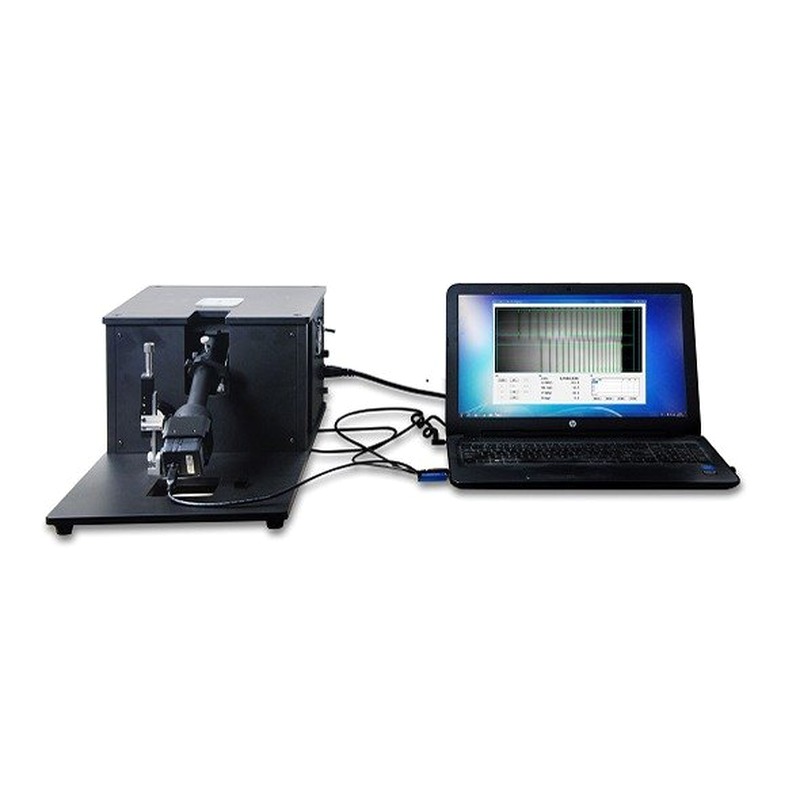
JF-4 Series is developed to automatically measure surface stress of chemically tempered and thermally tempered glass. The product uses the optical waveguide effect for calculation of surface compression stress, depth of layer, and central tension stress for tempered glass. The PC software supports single measurement, continuous measurement, chemical-glass stress-distribution inspection, records, and printed reports.
Newly released software includes features suitable for double ion-exchange glass, stress-distribution display, continuous measurement, continuous CSV recording, and report export. The measurement range is 1000 MPa or 1500 MPa. This is a strong inquiry trigger for a chemically strengthened glass team that needs a series of readings and a reviewable file, but chemistry, sample plan, and output schema still need confirmation.
JF-4 Series Facts That Shape a Continuous-Recording Inquiry
| Confirmed detail | Why it matters |
|---|---|
| Automatic optical-waveguide measurement | Define whether the request concerns surface compression, DOL, central tension, or all three. |
| Single and continuous measurement | Match the workflow to the buyer’s sampling plan rather than promising a universal throughput. |
| Chemical-glass stress-distribution inspection | Distribution may be more useful than one isolated point for process review. |
| Continuous CSV recording and report export | Ask who owns the file, fields, naming, and review route. |
| 1000 MPa or 1500 MPa range | Compare chemistry and target stress before selecting a configuration. |
| 5–50, 10–100, and 10–200 µm DOL ranges | Define the expected depth range explicitly. |
| Customization available | Changed chemistry, fixture, software, or report needs can become a scoped feasibility discussion. |
Continuous Data Is Only Valuable When the Sampling Plan Is Clear
“Record continuously” can mean a timed sequence, a set of points, a distribution scan, or a model-development experiment. Before buying, define sample size, interval, location, glass chemistry, ion-exchange condition, and the action taken when a value moves outside the working window. JF-4 Series gives the discussion a PC workflow with continuous measurement, records, and CSV/report outputs; it does not choose the buyer’s sampling or acceptance logic.
The same discipline applies to double-ion-exchange glass. The newly released software includes features suitable for double ion-exchange glass and stress-distribution display, but suitability remains a sample and configuration question. A buyer who sends chemistry and representative samples can get a much more useful review than one who asks whether the system “handles all chemical glass.”
Three Reasons to Put JF-4 Series on the Shortlist
1. Move from a single number to a distribution discussion
If the process team needs to see how stress changes across samples or a run, continuous measurement and stress-distribution inspection provide a defined direction. Use the listed 1000 MPa or 1500 MPa range and DOL options to frame the target. Then confirm the exact sample and optical conditions before making an acceptance claim.
2. Treat CSV as a quality-system requirement
Ask what every row must contain: sample ID, position, time, operator, chemistry, configuration, and any review status. Continuous CSV recording and report export are confirmed workflow features; the buyer should still specify naming, storage, retention, and downstream use. Do not assume an API, MES, SPC, or cloud database is included.
3. Use customization to close the real gap
If the project needs a non-standard DOL, wavelength, fixture, report, or software handoff, state the requirement. The product can be customized according to requirements, so a profitable project may be possible even when the standard page does not answer every detail. That is an engineering review, not permission to publish an unsupported capability as if it already exists.
Chemistry Must Be a Gate, Not a Footnote
The product cannot be applied to chemically tempered glass produced by Li+ in glass and Na+ in salt-bath ion exchange or to chemically tempered photochromic glass. That exclusion should be checked early. Send composition, ion-exchange route, target stress, DOL, thickness, and sample geometry before asking for a final configuration.
For another ion-exchange measurement route, compare the JF-2E Glass Surface Stress Meter. For a broader portfolio discussion, review the Surface Stress Meter range.
Send These Inputs for a CSV and Distribution Review
- Glass chemistry and ion-exchange route, including whether double ion exchange is involved
- Target surface stress, central tension, DOL, range, and wavelength preference
- Sample size, points, interval, and continuous-measurement definition
- Required CSV columns, report format, storage, and downstream system
- Quantity, destination, budget, and schedule
FAQ
Does continuous CSV recording mean a ready-made MES or API integration?
No. CSV recording and report export are confirmed workflow features; integration requirements need a separate specification review.
Can JF-4 Series measure every chemically strengthened glass?
No. Confirm chemistry and exclusions. The listed product cannot apply to Li+ in glass/Na+ salt-bath glass or chemically tempered photochromic glass.
Does continuous measurement guarantee a particular throughput?
No. Sampling plan, sample geometry, configuration, and site workflow must be reviewed.
Post time: Aug-27-2026