
JF-3E is an automatic surface-stress meter for thermally toughened, heat-strengthened, annealed, and tin-side float glass. Its measurement range is 200 MPa (29,000 psi), with a calculation speed of 0.5 second. For teams comparing a JF-3E automatic glass surface stress meter, those facts make it a strong candidate for replacing a slower manual calculation step with a more structured measurement workflow.
Resolution is 0.1 MPa, 15 psi, or 0.1 degree. JF-3E combines a measuring instrument, an adjustable PDA interface, and PC software. The first buying decision is whether the glass treatment, float-glass side, transmission, coating, curvature, target range, and measurement environment match this configuration—not simply whether the buyer wants an “automatic” meter.
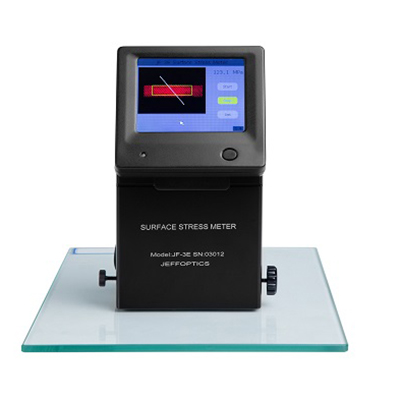
The JF-3E Glass Surface Stress Meter provides the model context for this selection guide.
Why Faster Calculation Matters—but Does Not Define the Entire Cycle
When a quality team is checking repeated samples, a slow calculation or manual fringe-angle step can delay comparison. A faster result can help the operator move from measurement to the next decision sooner: repeat the point, compare another sample, review a process condition, or escalate an unexpected value.
JF-3E calculates in 0.5 second. That is a calculation-speed fact, not a guaranteed factory cycle time. Total inspection time still depends on sample identification, cleaning, positioning, optical contact, point count, operator movement, data handling, and the buyer’s acceptance procedure.
The commercially useful question is therefore: where does automatic calculation remove friction in your current process, and which surrounding steps still need method development or integration?
JF-3E Facts That Shape the Measurement Plan
| Decision factor | JF-3E configuration |
|---|---|
| Operating mode | Automatic surface-stress measurement |
| Glass scope | Thermally toughened, heat-strengthened, annealed, and tin-side float glass |
| Measurement range | 200 MPa (29,000 psi) |
| Calculation speed | 0.5 second |
| Resolution | 0.1 MPa, 15 psi, or 0.1 degree |
| Operator interface | PDA with a 3.5-inch touch screen |
| Computer support | PC software |
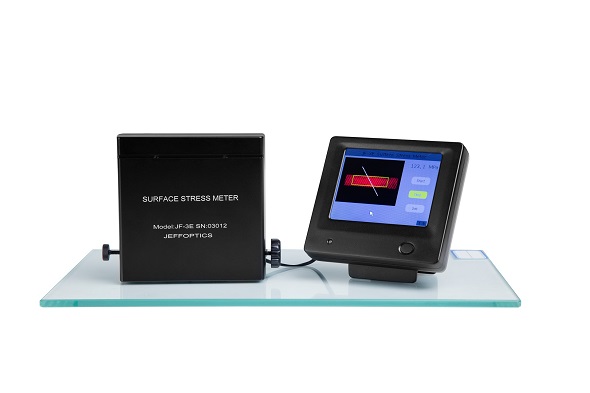
| Physical arrangement | PDA and measuring instrument connected by a clamp; adjustable hinge angle |
| Work environments | Laboratory, production-line, and field testing |
| Application examples | Architectural, automotive, and solar glass |
| Automotive examples | Windshields, side windows, sunroofs, and back windows |
JF-3E includes PC software and a PDA with a 3.5-inch touch screen. The PDA provides measure and set views. This creates a defined operator interface, but buyers should confirm the exact PC functions they need rather than assuming the presence of reports, databases, exports, or plant-system connections.
Three Operational Reasons to Evaluate JF-3E
1. Reduce the Manual Calculation Bottleneck
A manual surface-stress routine can require the operator to interpret a fringe angle and calculate a result. When the same task is repeated across samples or process conditions, that calculation step can become a bottleneck and a source of inconsistency.
JF-3E is automatic and returns the calculation in 0.5 second. The practical value is not an abstract claim of “efficiency.” It is earlier access to a result that the quality or process team can use in its next action.
Buyers should validate the full routine with their own samples. A fast calculation cannot correct the wrong glass side, unsuitable curvature, poor optical contact, incorrect positioning, or an acceptance rule that has not been defined.
2. Give the Operator a More Defined Viewing Arrangement
Instrument posture matters when a measurement depends on optical viewing and sample contact. If operators hold or view equipment differently, a work instruction can become difficult to standardize.
The PDA and measuring instrument are connected by a clamp, and their angle can be adjusted by a hinge. That physical arrangement gives the buyer a concrete basis for defining operator position and screen visibility.
The buyer should still test the arrangement with actual sample dimensions and measurement locations. Large panes, curved glass, installed glass, restricted edge access, or a different work height may justify a support, fixture, or tailored setup.
3. Use One Product Route Across Several Quality Contexts
The product is positioned for laboratory, production-line, and field testing. Application examples include architectural, automotive, and solar glass. This gives a multi-site or multi-function quality team a useful starting point when the same physical quantity must be reviewed in different controlled contexts.
That does not mean one unchanged procedure fits every environment. A laboratory may prioritize controlled repeat measurements, a production team may prioritize point count and operator flow, and a field team may prioritize access and sample orientation. Define the decision and environment before assuming a common work instruction.
Which Glass Conditions Fit the Standard JF-3E Conversation?
JF-3E covers thermally toughened, heat-strengthened, annealed, and float glass measured on the tin side. It is relevant to architectural, automotive, and solar-glass discussions. Automotive examples include windshields, side windows, sunroofs, and back windows.
Special optical conditions such as low-transmission glass and certain coated optical glass are also part of the JF-3 series application discussion, but they should be evaluated with the actual sample. Transmission percentage, coating, glass side, curvature, and optical contact can all affect whether the standard method is appropriate.
The wider Surface Stress Meter range includes manual, assisted, portable, wireless, and PC-based routes. Choose by glass and decision, not by model name alone.
Changed Conditions That Should Become an Inquiry
Curved Glass
JF-3H is a separate JF-3E variant with a curved prism for surfaces with a 200 mm radius. Do not treat that condition as a standard JF-3E feature. Send the minimum and maximum radius, pane dimensions, measurement locations, glass type, and access direction so Jeffoptics can evaluate the correct variant or a tailored arrangement.
Chemically Strengthened Glass
JF-3E is centered on the thermal, annealed, and tin-side float-glass scope above. A chemically strengthened sample introduces a different measurement question. Provide composition, treatment route, expected surface stress and layer depth, and the current reference method so another Jeffoptics meter can be evaluated.
Unusual Transmission, Coating, or Surface
Low transmission and coatings can change the optical measurement condition. Send representative samples rather than relying only on a material description. A sample review can determine whether the standard optical route, a special setup, or another method deserves further work.
Automation and Data Integration
Automatic calculation and PC software do not create a complete online station. If the buyer needs automatic loading, barcode input, recipes, multi-point motion, reports, database storage, API access, or MES/QMS connection, define those functions as project requirements.
Jeffoptics can evaluate hardware development, software development, fixtures, and system integration. That opens a commercially useful route beyond the standard meter without promising feasibility, cycle time, data architecture, or delivery before engineering review.
JF-3E Versus a Semi-Automatic Route
The JF-3B Glass Surface Stress Meter is a relevant comparison when the buyer is deciding how much automation is needed. JF-3E is automatic and has PC software; the JF-3B route is semi-automatic and PDA-assisted.
Compare:
- operator involvement in identifying and calculating the result;
- samples and points per inspection period;
- glass treatment, side, transmission, and curvature;
- need for PC-based work;
- location of use;
- validation and training plan; and
- future fixture, software, or integration needs.
The correct choice is the one that removes the buyer’s actual bottleneck without adding unneeded complexity.
A Practical Validation Plan
- Select representative panes for each treatment, thickness, coating, transmission, and curvature condition.
- Confirm the tin side where the method requires it.
- Define measurement points and the reason each point matters.
- Record the target range and units.
- Compare results with the buyer’s reference samples or method.
- Measure repeat samples with the intended operators and environment.
- Review how the PDA and PC workflow fit the work instruction.
- Define which result triggers a repeat, process review, batch decision, or further test.
This validation separates a useful automatic workflow from a purchase based only on calculation speed.
What to Send for a Technical Quotation
Send the glass type and thermal treatment, float-glass side, dimensions, thickness, curvature, transmission, coating, target stress and units, measurement points, samples per shift, lab/line/field environment, PC and data requirements, expected quantity, destination, budget range, and schedule.
Jeffoptics can use those inputs to compare standard JF-3E fit, JF-3B, a curved-prism variant, another surface-stress meter, or a tailored hardware, software, fixture, and integration project. A condition outside the standard model should start a better technical conversation, not end the inquiry.
Frequently Asked Questions
What glass does JF-3E measure?
JF-3E applies to thermally toughened, heat-strengthened, annealed, and tin-side float glass. Exact fit also depends on transmission, coating, curvature, thickness, and measurement conditions.
Is 0.5 second the total inspection cycle?
No. It is the calculation speed. Total time depends on sample handling, positioning, point count, operator flow, validation, and data handling.
Does standard JF-3E measure 200 mm curved glass?
The 200 mm radius condition belongs to JF-3H, a separate curved-prism variant. Submit the actual curvature and sample geometry for model review.
Do the ASTM and EN references mean certification?
No. They identify measurement contexts for the JF-3 series and should not be presented as product certification or guaranteed compliance.
Can JF-3E be integrated into a production system?
JF-3E includes PC software, but automated handling, custom fixtures, reports, interfaces, and line integration require a defined feasibility project.
Post time: Jul-29-2026