
A phone-connected stress meter is useful only when it gives a quality team a more disciplined way to identify the glass, choose the right measurement version, compare a result, and retain the information needed for the next decision. WiFi by itself is not a factory data architecture, a cloud platform, or a substitute for the buyer’s acceptance process.
JF-1Wifi is applied to surface-stress measurement of thermally toughened, heat-strengthened, and annealed glass on the tin side using the enhanced GASP method. The stress meter connects to a mobile phone through WiFi. The measurement range is 15–300 MPa. For a buyer managing routine checks across a laboratory, process-review point, or several operators, those facts create a clear route to evaluate a mobile measurement workflow before committing to a wider data or automation project.
The first question is not “Can a phone show the result?” It is whether the buyer can identify the glass type, tin-side condition, target range, required record, measurement location, reference method, and person responsible for accepting or escalating the result. Once those conditions are clear, JF-1Wifi can be assessed as a defined instrument workflow rather than a generic connected device.
JF-1Wifi facts that affect buyer fit
| Buyer question | JF-1Wifi fact | What the buyer should confirm |
|---|---|---|
| What glass task is supported? | JF-1Wifi measures the surface stress of thermally toughened, heat-strengthened, and annealed glass on the tin side using the enhanced GASP method. | Confirm material, treatment, tin-side access, optical condition, and the decision that the reading must support. |
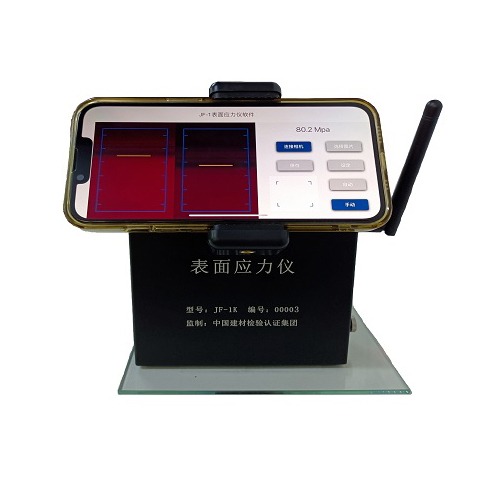
| How is the result handled at the work point? | The stress meter connects to a mobile phone through WiFi. Stress-value calculation, recording, and stress-meter settings can be completed on the mobile phone. | Define which fields must be recorded, who reviews them, and whether a wider data path is required. |
| Is one version suitable for every glass type? | The product has three versions: a tempered soda-lime glass version, a tempered borosilicate glass version, and a multi-functional dual-light-source version for tempered soda-lime and tempered borosilicate glass. | State the actual glass composition and treatment before requesting a quotation. |
| What range and resolution are relevant? | The measurement range is 15–300 MPa. Resolution is 2.3 MPa for soda-lime glass and 1.9 MPa for borosilicate glass. | Compare the project’s target range and decision threshold with the applicable version. |
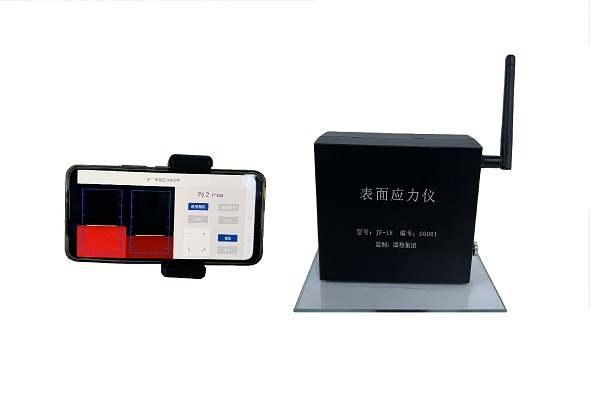
| How can the phone be positioned? | It includes a mobile phone and phone mount for attached or detached use. | Review access to the sample, viewing position, support arrangement, and work area. |
1. Move the calculation and record into the measurement routine
Many quality teams do not need a dramatic new system. They need a consistent measurement routine that does not split the sample, the setting, the calculation, and the record across unrelated steps.
JF-1Wifi lets the stress value be calculated, recorded, and configured on the connected mobile phone. That can help a team structure a local routine around the moment it checks the sample: identify the panel, confirm the glass version, establish the measurement point, calculate the value, and keep the record that the next engineer or buyer conversation will need.
The commercial value is not an automatic claim of traceability or compliance. It is a clearer starting point for defining the buyer’s own process. Before selection, decide whether the record needs only the result and sample identifier or whether the project requires a report, a database, a customer-specific form, an API, MES/ERP connection, or a broader quality workflow. Only the mobile calculation, recording, and settings named above are current JF-1Wifi facts; any wider data requirement belongs in a software or system-integration feasibility conversation.
2. Treat version choice as part of the technical decision
The biggest avoidable mistake is to describe a mobile stress meter as if all heat-treated glass is one measurement condition. It is not. JF-1Wifi has distinct soda-lime, borosilicate, and dual-light-source versions. That is a useful commercial advantage because it forces the RFQ conversation to begin with the material rather than with a vague request for “a WiFi meter.”
Start with these questions:
- Is the sample tempered soda-lime glass, tempered borosilicate glass, or another construction requiring review?
- Is the required surface accessible on the tin side?
- Which 15–300 MPa decision range matters to the buyer?
- Does the measurement team need one material route or a dual-light-source workflow?
- Which settings, sample identifiers, and results have to be visible in the buyer’s local procedure?
If the material, treatment, or optical condition is uncertain, submit it for review rather than choosing a version from a generic product label. That keeps the sales conversation open while protecting the quality team from a premature compatibility promise.
3. Plan the mobile work point, not just the instrument
The JF-1Wifi dimensions are 120 × 101 × 46 mm and the weight is 0.6 kg. It includes a mobile phone and phone mount for attached or detached use. These are practical details for planning how the instrument will be held, viewed, or placed during a local measurement routine.
They are not proof of one-person operation, weather resistance, universal field use, or suitability for every production environment. The buyer should send sample photos, dimensions, curvature, available access, work-area conditions, and the intended measurement locations. That allows Jeffoptics to compare a standard mobile workflow with a different surface-stress route or a tailored fixture and software discussion.
Where JF-1Wifi is worth evaluating
JF-1Wifi is worth evaluating when the buyer can define the following:
- The glass is thermally toughened, heat-strengthened, or annealed, and tin-side measurement is the intended route.
- The applicable version is soda-lime, borosilicate, or the dual-light-source configuration after material review.
- The 15–300 MPa range and the stated resolution for the relevant glass type meet the project’s measurement objective.
- The team has a local method for sample identification, measurement location, settings, result review, and acceptance escalation.
- A connected mobile workflow is the actual need—not an assumption that WiFi already provides an enterprise data system or automated line station.
For buyers whose requirement extends beyond those conditions, the right next step is a project review. A changed configuration may involve a different model, a modified hardware setup, a special fixture, a required record format, a software function, or a system-integration scope. Jeffoptics can evaluate that requirement after the buyer supplies the technical and commercial inputs.
What to include in a JF-1Wifi RFQ
Send the following information for a useful model or feasibility review:
- Glass composition, treatment route, and whether the tin side is known.
- Soda-lime, borosilicate, or dual-material requirement; include any available data sheet or representative sample details.
- Sample dimensions, thickness, curvature, coating condition, measurement locations, and target range.
- Current method, reference sample or internal specification, acceptance owner, and reason for the measurement.
- Required mobile record fields, number of users, number of measurement points, frequency, and any report, export, database, API, MES/ERP, or integration requirement.
- Quantity, destination, budget range, project timing, installation or training need, and whether a standard, modified, or custom route is acceptable.
See the JF-1Wifi product page and the Surface Stress Meter category for the portfolio context. For a PDA-centered alternative, review JF-1E.
FAQ
Does WiFi mean JF-1Wifi includes a cloud or MES system?
No. The confirmed current functions are connection to a mobile phone for calculation, recording, and settings. A cloud database, API, MES/ERP connection, remote control, or a line system needs a separate software or system-integration feasibility review.
Can one JF-1Wifi version measure every glass type?
No. The product has soda-lime, borosilicate, and dual-light-source versions. Send the glass composition, treatment, and measurement objective so the correct route can be reviewed.
Can JF-1Wifi measure both sides of any glass panel?
The standard product task is tin-side measurement using the enhanced GASP method. Confirm the glass side, construction, access, and optical condition before selection.
Is a mobile record the same as a final quality release?
No. The buyer must define the comparison method, acceptance criteria, documentation, and person responsible for the final decision.
What is the first step for a customised mobile workflow?
Share the sample, glass type, target range, measurement locations, record fields, data destination, user workflow, quantity, destination, budget, and timeline. Jeffoptics can evaluate a standard, modified, or custom measurement route.
Post time: Aug-06-2026