
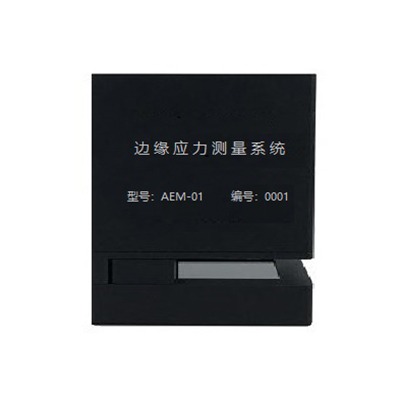
A glass sheet can look acceptable yet still leave a solar-glass quality team with an unresolved question at its edge. A measured edge-stress distribution gives the team one piece of evidence to compare processing conditions or incoming sheets before assembly. The Jeffoptics AEM-01 Automatic Edge Stress Meter is a candidate for that review: AEM-01 uses the photoelastic principle for non-destructive glass edge-stress measurement. Measurement length is 50 mm. Its fit depends on the actual glass, edge and optical conditions.
What the AEM-01 measures
It measures stress distribution from compression to tension at about 12 Hz. The measurement range is ±150 MPa at 4 mm, ±100 MPa at 6 mm, or ±1600 nm; the range can be customized. Application examples include architectural glass, automotive windshields, sidelites, backlites, sunroof glass, and solar patterned glass.
| AEM-01 reference | Listed detail |
|---|---|
| Measurement | Non-destructive photoelastic edge stress distribution |
| Measurement length | 50 mm |
| Range | ±150 MPa at 4 mm; ±100 MPa at 6 mm; or ±1600 nm |
| Software | Settings, measurement, alarm, record and report |
Configuration reference: AEM-01 official product information, verified July 2026. The stated ranges are tied to their listed thicknesses; review the sample and any customised range before quotation.
Compare selected edge locations before assembly
Solar-glass processing teams often need to decide whether a change in sheet, edge preparation or heat treatment warrants closer investigation. A 50 mm segment gives a defined measurement location to associate with a specific sheet and process history. Select corresponding locations on representative specimens, identify the edge and keep the location consistent when making a comparison. A reading is most useful when the team knows which decision it is intended to inform.
The measurement is non-destructive, so the specimen can remain available for other planned checks. That does not make the edge-stress result a substitute for visual edge inspection, fracture testing, or finished-module evaluation. Each answers a different question.
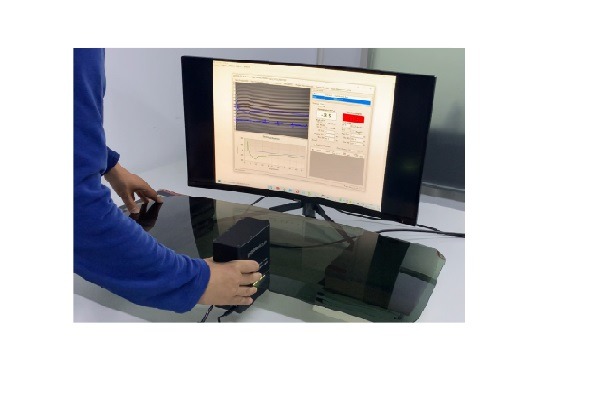
Use a distribution instead of a single undocumented observation
The instrument measures the distribution from compression to tension. That supports a discussion of what is happening within the measured segment instead of treating an edge as a single unqualified number. Software functions include setting, measurement, alarm, record, and report. A quality team can establish its own sample identifier and decision criteria, then retain the relevant records with the process conditions used for comparison. An alarm is not itself a customer acceptance standard.
Check the actual sheet and edge
Patterned solar glass is an application example, but a particular texture, coating, thickness or edge geometry still needs review. Identify the sheet construction and the side and edge available to the instrument. Bring representative samples and describe how they are supported, what area must be measured and whether the optical conditions are suitable. Compare the expected range with the value for the actual thickness; do not transfer the 4 mm range to a different thickness.
If a standard presentation or range does not match the job, Jeffoptics can evaluate a customised measurement configuration or related fixture and software requirements. Agree on feasibility and acceptance criteria before treating a proposed setup as an established capability.
Request a solar glass sample review
Send glass composition and treatment, thickness and dimensions, pattern or coating, edge finish and photos, expected range, measurement locations, sample availability, throughput and record requirements. Include quantity, destination, budget range and project timing. Review the AEM-01 or request a sample review.
Frequently asked questions
Does a solar glass edge-stress reading qualify a finished module?
No. It provides evidence about the measured glass edge. Module qualification and other glass checks have their own requirements.
Can the same stress range be assumed for every sheet thickness?
No. The listed stress ranges are associated with specified thicknesses; review the intended thickness and required range with Jeffoptics.
Post time: Nov-09-2026