
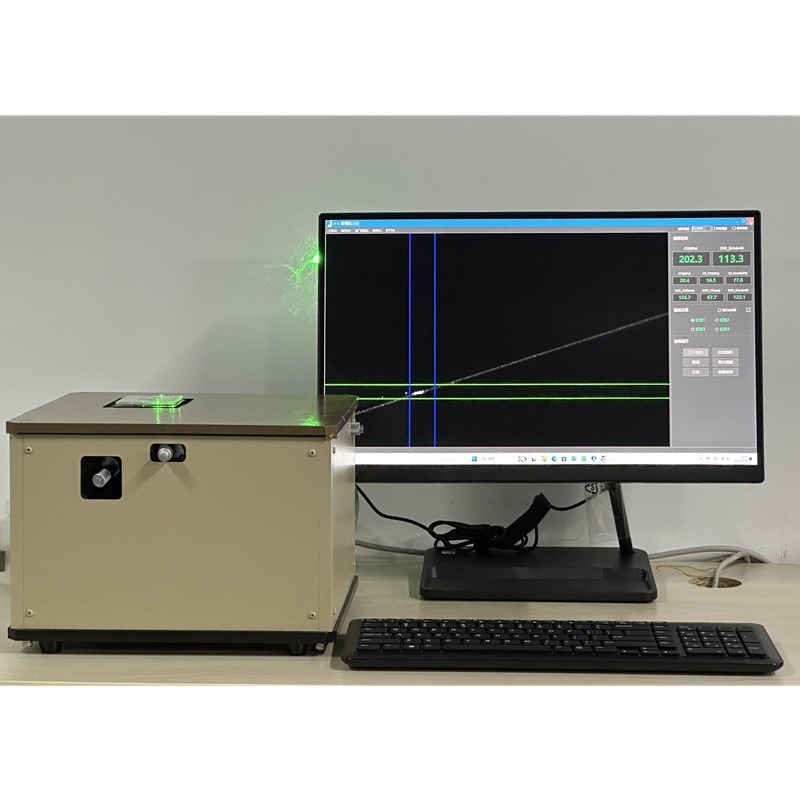
Chemical-strengthening development needs a measurement plan that can distinguish treatment trials, rather than selecting a recipe from one surface value. JF-6 uses scattered light photoelasticity to measure the stress distribution of chemically tempered glass. The stated stress range is CS 0~2000 MPa. It is worth evaluating for flat-glass development programs where the engineering question concerns stress through depth and the relationship between a treatment change and the resulting profile.
JF-6 can measure the stress distribution of chemically strengthened glass with Li+ to Na+ ion exchange. That gives laboratories working with this route a concrete method to discuss. It does not make every composition or treatment sequence an automatic match; sample conditions and the required output still define the evaluation.
A stress-distribution route for development samples
The instrument helps the R&D engineer ask a more specific question: how did the measured distribution change between controlled treatment trials? The useful output is evidence for comparing trial samples. The engineer remains responsible for relating that evidence to mechanical tests, material requirements and the next process experiment.
| JF-6 configuration reference | Development-planning implication |
|---|---|
| Scattered light photoelasticity | Discuss the required stress-distribution measurement with the laboratory. |
| CS 0~2000 MPa | Compare the required stress range with the intended configuration. |
| DOL 10~600 μm | Define the depth question and the meaning of the requested output. |
| Flat sample | Supply actual sample geometry before proposing a test routine. |
| 520 nm laser below 10 mW | Plan the instrument installation and operating conditions through a technical review. |
| JF-6 Glass Stress Meter Software | Evaluate the actual software workflow against the laboratory’s needs. |
The stated depth-of-layer range is DOL 10~600 μm. The sample size is flat. Review dimensions, thickness, surface condition and any coating with Jeffoptics rather than treating “flat” as unlimited sample acceptance.
Look beyond a single surface-stress value
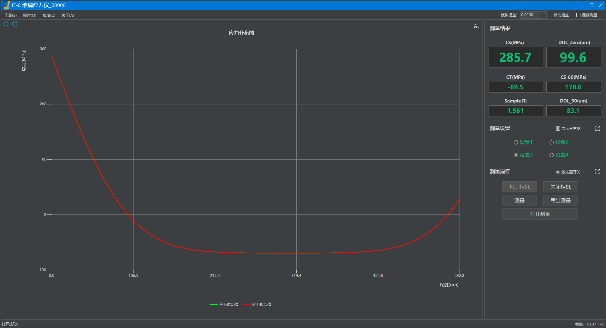
During process development, two samples can prompt different questions even if their surface values appear similar. The required investigation may concern a deeper region or a change in profile shape. A distribution-oriented measurement keeps that question visible instead of reducing the entire development program to one scalar result.
Research on ion-exchange stress profiles discusses composition-dependent behavior and how treatment time can influence the position and shape of compression within the glass. The measurement lesson is to define which part of the profile matters to the experiment. Do not assume that a higher surface value or a longer treatment is always the better recipe.
JF-6′s distribution-measurement role supplies a candidate route for that comparison. Agree the output definitions and usable sample conditions before using results to rank trials.
Tie each sample to a controlled treatment change
Prepare a trial matrix that identifies the substrate, treatment sequence and variable being changed. Retain traceable identifiers for untreated references or established-process samples where those are part of the laboratory’s plan. Compare samples with controlled thickness, position and preparation so that the treatment variable is interpretable.
For example, a team comparing two treatment durations should record which other conditions remained fixed. If composition and bath conditions also changed, the data describe a broader change and do not isolate duration. This is experimental-design guidance, not a JF-6 recipe recommendation.
The decision value is a better next experiment: retain the promising condition, investigate a profile difference or redesign the comparison. Stress-distribution data contribute to that decision without guaranteeing a specific strength improvement or identifying a unique failure cause.
Keep location differences visible during review
A development program may also need to know whether nominated sample positions differ. Define those positions before measurement and keep their identifiers with the associated treatment records. Repeatability and position questions should be evaluated deliberately rather than mixed into the treatment comparison.
JF-6 uses JF-6 Glass Stress Meter Software. Review the demonstrated software workflow against the outputs the team needs. Sample identifiers, recipe links, automated comparisons, report templates and database connections should be specified as requirements when needed; they should not be assumed to be current functions.
For a more extensive trial program, Jeffoptics can evaluate software development or system integration around the laboratory’s record and review process. Supply a desired record structure and explain who will use it to make which decision.
Choose a measurement project around the experiment
The JF-6 Glass Stress Meter applications include chemically tempered glass, double ion-exchange glass and thermally tempered glass. Keep the method discussion tied to the actual material and experiment. Curved samples, unusual coatings, new treatment sequences or automated loading are reasons for a feasibility review.
Send the glass composition or supplier designation, ion-exchange sequence, thickness, flat-sample dimensions, surface condition and intended measurement locations. Describe the required stress/depth outputs, trial count, current comparison method and decision criteria. Include quantity, installation country, data needs, budget range and timeline.
Request a JF-6 development-measurement review to compare a standard instrument route with a tailored hardware, software or integration project. Any proposed customization needs technical and commercial evaluation before its feasibility or performance can be committed.
FAQ
Can JF-6 support a Li+ to Na+ ion-exchange investigation?
Its measurement role includes stress distribution in chemically strengthened glass using that exchange route. Provide the composition, process and flat-sample details for a project-specific review.
Will a stress profile identify the best strengthening recipe?
It supplies measurement evidence. Recipe selection also depends on the development objective, controlled experiments and any required mechanical or acceptance tests.
What if the laboratory needs automatic trial comparisons?
Send the desired inputs, comparison outputs and record format as a software-development requirement for feasibility evaluation.
Post time: Oct-15-2026