
Laboratory quality control for ion exchanged glass needs a measurement plan that separates the physical question from the eventual release decision. JF-2E uses the optical waveguide effect to measure surface stress in chemically tempered and thermally tempered glass. The measurement range is 1000 MPa, and the depth-of-layer range is 100 µm. The accuracy specification is 20 MPa for stress and 5 µm for depth of layer. These details make JF-2E worth evaluating when a laboratory needs to organize surface-stress and depth-of-layer review around a known sample and method context.
For an ion-exchanged-glass program, the material, treatment route, sample condition, target values, and acceptance limits must be supplied by the buyer. The instrument gives the team a defined measurement route; it does not certify a chemistry, compatibility, or product result.
What JF-2E contributes to laboratory control
| Confirmed item | Buyer planning use |
|---|---|
| Optical-waveguide measurement for chemically and thermally tempered glass | Identifies the stated measurement context. |
| 1000 MPa stress and 100 µm DOL ranges | Frames the parameters that the laboratory wants to review. |
| 20 MPa stress and 5 µm DOL accuracy specifications | Helps the buyer discuss required reading detail. |
| Separate chemical and thermal interfaces | Keeps method setup visible rather than treating all glass work as one mode. |
| Portable PDA-based configuration | Supports a defined workstation or review location. |
Configuration reference
The confirmed product is the JF-2E Glass Surface Stress Meter. Its public product information was reviewed in September 2026 for the stated stress and depth-of-layer measurement role. JF-2E is a portable version with a 3.5-inch PDA and a 4000 mAh battery. Before a quotation or selection decision, technical review should cover the glass material, ion-exchange route, sample geometry, target range, and the buyer’s use of results.
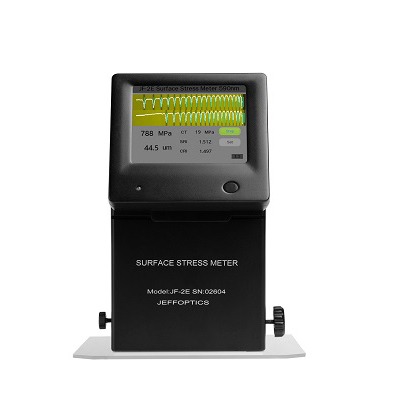
Buyer decision: state the measurement question first
The laboratory should begin by naming the decision that the measurement needs to support: process-development comparison, lot review, sample investigation, or another internally defined quality step. That choice determines the samples, repeat plan, records, and review owner.
Software provides separate measure and set views, with different measurement interfaces for chemically and thermally tempered glass. This helps the team keep the method context explicit. It should not be used as a shortcut around confirming the actual material and procedure.
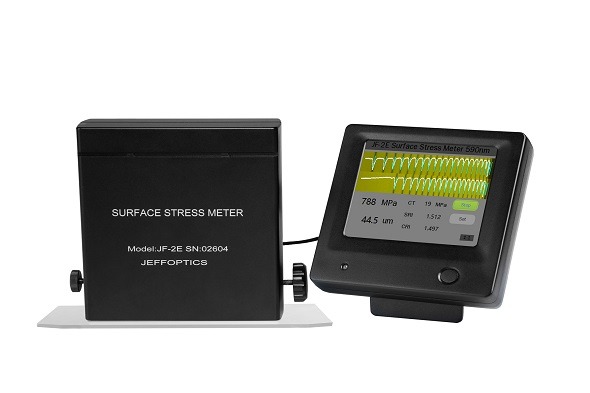
Application/support: keep the setup inputs visible
For technical work, settings are part of the measurement conversation. The set view includes serial number, thermal-glass measurement selection, glass thickness, photoelastic coefficient, glass-core refractive index, and factor 1. A buyer can use this list as an RFQ prompt: identify the available glass data, the proposed mode, and the parameters that require technical discussion before measurement planning.
This reduces a common procurement problem: asking for a meter without defining the sample and decision context it must serve. The practical value is a more focused laboratory conversation, not an implied result for every ion-exchanged glass build.
Application/support: plan how results will be reviewed
Stress and depth-of-layer values are useful only when linked to the buyer’s own comparison or acceptance approach. Identify whether results need to be repeated, recorded, compared with a target, or discussed with a process-development group. Keep the rule that acts on those results in the laboratory’s quality system.
If the project involves unusual sample handling, fixture needs, settings, reporting, or system interfaces, Jeffoptics can evaluate a tailored hardware, software, fixture, reporting, or system-integration route. Send the application details for a feasibility review rather than assuming a standard configuration covers them.
What to send for a JF-2E laboratory review
Send the glass material and treatment route, sample geometry and condition, proposed chemical or thermal measurement context, target stress and DOL range, glass thickness and available parameters, repeat plan, record or reporting need, quantity, destination, budget range, and schedule. These inputs establish whether the proposed measurement route fits the laboratory task.
FAQ
Does JF-2E guarantee a result for every ion-exchanged glass sample?
No. The buyer’s material, treatment route, geometry, method settings, and acceptance requirements require technical review.
Why discuss both stress and depth of layer?
JF-2E has stated ranges for surface stress and depth of layer, so the laboratory should define which measurement questions it needs to answer before selecting a workflow.
Can a specialized laboratory setup be discussed?
Yes. Jeffoptics can evaluate a tailored measurement, fixture, software, reporting, or system-integration requirement from the project details.
Post time: Sep-23-2026