
By Jeffoptics Technical Department | Updated: March 2026
In the era of Advanced Driver Assistance Systems (ADAS) and Head-Up Displays (HUD), the optical quality of a vehicle’s windshield is no longer just about visibility—it is a critical safety parameter. Among various optical aberrations, Secondary Image Separation (SIS) stands out as a primary challenge for glass manufacturers.
If not strictly controlled, this phenomenon can lead to “ghosting,” causing driver fatigue and, more critically, misinterpretation of road data by onboard camera systems.
The Physics of Ghosting: Why Secondary Images Occur
Secondary images are formed when light reflects between the two surfaces of a laminated glass pane before reaching the observer’s eye or a camera sensor. While a perfectly parallel glass would align these images, the aerodynamic curvature and installation angles of modern windshields often create a wedge angle.
When this wedge angle exceeds industry tolerances (such as ECE R43 standards), the primary and secondary images separate significantly. identifying these defects during the R&D or batch testing phase is non-negotiable.
Critical Challenges in SIS Detection
Traditional manual inspection methods are increasingly obsolete due to:
-
Human Error: Visual fatigue leads to inconsistent measurement of separation angles.
-
Precision Demands: Modern HUD-compatible glass requires resolution down to 0.1 arcmin.
-
Complex Geometries: Testing at various viewing angles (Horizontal ±15°, Vertical ±10°) is mathematically intensive for manual setups.
Jeffoptics’ Solution: The SIS-Lab Version System
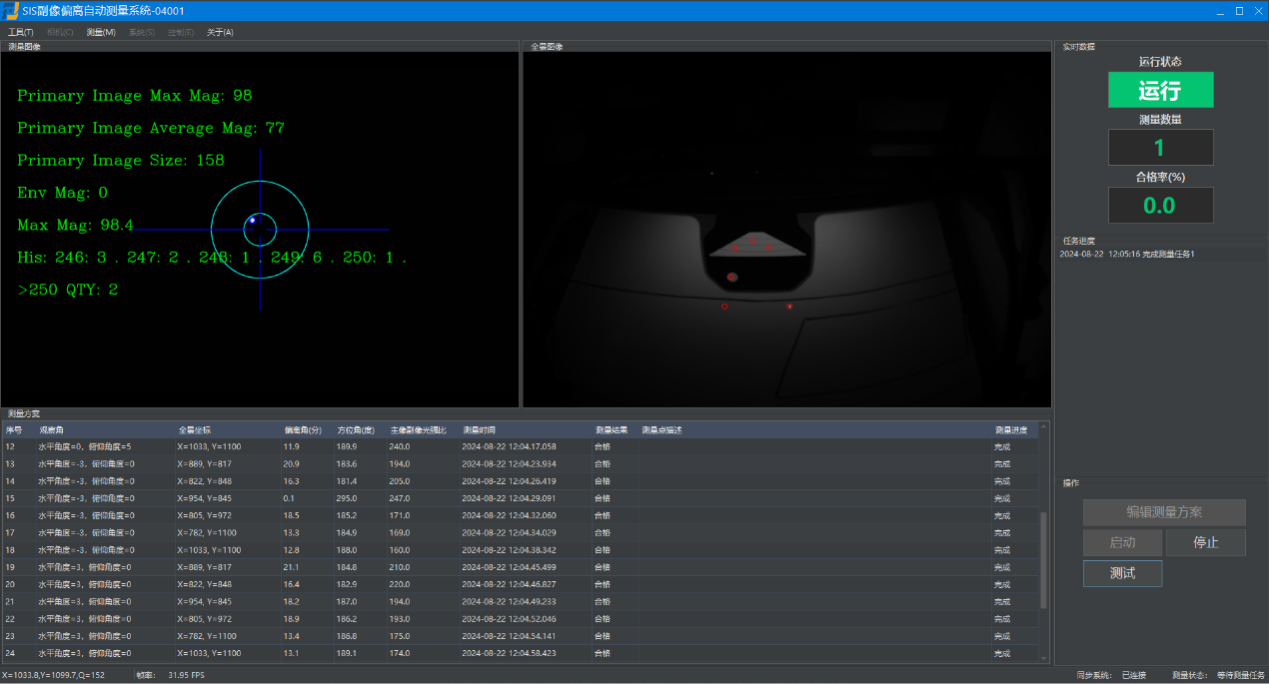
To address these challenges, Beijing Jeffoptics Company Limited has engineered the Secondary Image Separation Test System – Lab Version. This system isn’t just a measurement tool; it’s an integrated quality assurance hub designed for high-stakes environments.
The Jeffoptics Standard: Engineered for Precision
Unlike generic optical testers, the Jeffoptics SIS-Lab version utilizes the patented “PIERT” (Precision Image Extraction & Resolution Technology) to ensure that even at steep rake angles (15°~75°), the separation value remains accurate.
Key Technical Specifications
| Feature | Parameter / Capability |
| Measurement Range | 80′ * 60′ (Arc minutes) |
| Minimum Value | < 1′ (at general rake angles) |
| Repeatability | 0.4′ (for separation < 4′) |
| Sample Size Support | Up to 1.9m * 1.6m (Customizable) |
| Light Source | 532nm Laser (Polarization angle 45±5°) |
Driving Success Across Sectors: Application Scenarios
Our system serves as the silent backbone for several critical glass industries:
1. Automotive OEM and Tier 1 Suppliers
Ensuring that windshields meet the stringent requirements for ADAS camera zones. The SIS-Lab version can automatically identify the primary and secondary images, calculate the energy ratio, and export reports that serve as a digital “birth certificate” for the glass quality.
2. Aerospace and Cockpit Windows
High-speed aviation demands zero-distortion. Our system’s ability to test dedicated points at different viewing angles ensures cockpit glass meets extreme safety benchmarks.
3. High-Performance Architectural Glass
For luxury skyscrapers using thick laminated glass, the system prevents the “double vision” effect often seen in reflective coatings.
Conclusion: Partnering for Optical Excellence
As global standards like ECE R43 evolve and AI-driven vehicles become the norm, the margin for optical error is shrinking. Beijing Jeffoptics provides the precision metrology needed to navigate this complexity. By integrating our Secondary Image Separation Test System into your laboratory, you aren’t just buying equipment—you are securing your reputation for reliability.
Looking for a technical consultation on your glass testing requirements?
[Contact Jeffoptics Today] to speak with our engineering team about custom configurations for your specific sample sizes and loading angles.
Post time: Mar-06-2026