
— As global construction standards pivot toward “Extreme Durability” and “Zero-Spontaneous Breakage” mandates, the role of precise thermal stress management has moved from the laboratory to the forefront of the production line. With the recent updates to international safety glass standards, B2B procurement managers are increasingly prioritizing equipment that can guarantee edge integrity.
The Shift: From “Good Enough” to Quantitative Precision
In the past two months, the glass industry has seen a surge in demand for high-strength tempered and laminated glass, driven by the expansion of smart cities and high-rise infrastructures. However, this trend brings a significant challenge: Edge Stress Failure.
For procurement managers and quality controllers, the risk of spontaneous glass breakage due to improper edge treatment is no longer just a quality issue—it’s a massive liability. This has led to a global shift toward the Senarmont Compensation method, a more rigorous and repeatable measurement standard than traditional qualitative visual inspections.
Meeting the Standard with the Precision Edge Stress Meter
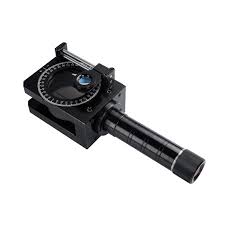
To address these tightening requirements, our latest Edge Stress Meter offers two critical advantages that solve the “unseen” risks in glass manufacturing:
1. Laboratory-Grade Accuracy via Senarmont Compensation
Unlike basic polarimeters, our meter utilizes the Senarmont Compensation method, allowing operators to calculate the optical path difference ($T$) with extreme precision. By rotating the polarization analyzer until interference colors vanish, users can derive exact values using the formula:
Where $\lambda$ is the light wavelength (560nm) and $\theta$ is the rotation angle. This eliminates human error and provides a quantitative “stress map” that is essential for high-spec B2B contracts where decimal-order value accuracy is non-negotiable.
2. High-Resolution LED Optics for Industrial Throughput
Modern glass processing happens in fast-paced environments. Our device is designed for on-site efficiency—featuring a 70mm clear aperture and a high-resolution (2°) scale dial. It allows for the measurement of glass thicknesses up to 28mm directly on the factory floor. With its integrated LED light source and portable 300mm design, it ensures that quality checkpoints do not become production bottlenecks.
Why B2B Buyers are Switching
For sourcing agents focusing on portable glass stress testing tools, non-destructive glass edge analysis, and ASTM-compliant stress measurement, this tool represents more than an instrument—it is insurance against product recalls. Whether you are managing optical path difference calculation or routine glass quality control, precision is the only path to market compliance.
Expert Perspective: The 2026-2027 Market Outlook
“The next 24 months will see a ‘quality shakeout’ in the glass industry. As AI-driven structural simulations become the norm in architecture, the tolerance for edge stress deviation is shrinking toward zero. We anticipate that quantitative stress documentation will soon become a mandatory attachment for every batch of structural glass. Manufacturers who adopt high-resolution Senarmont measurement tools now will secure a significant competitive edge in the high-end European and North American export markets.”
Optimize Your Quality Control Today
Don’t let edge stress be the weak link in your supply chain. Ensure your production meets the 2026 global safety standards with our precision Edge Stress Meter.
Ready to upgrade your QC process?
Post time: Jan-29-2026